
【應用科學系】恭賀邱泰嘉老師與胡焯淳老師研究成果獲選為英國皇家化學學會Analytical Methods期刊封面(Outside Front Cover)!
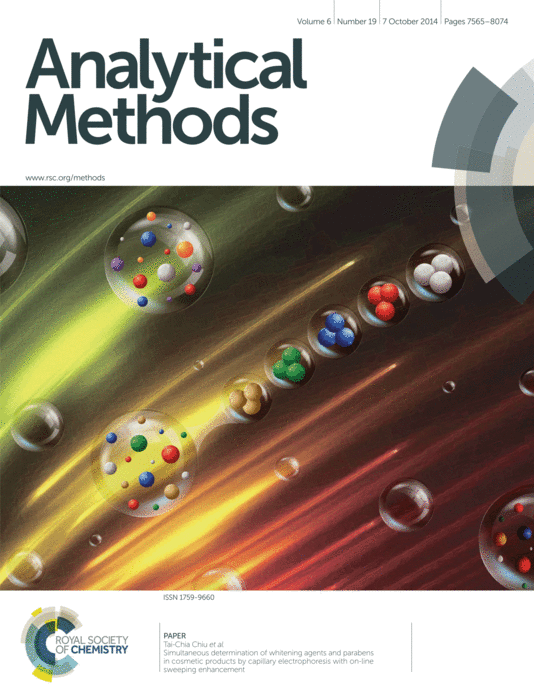
恭賀應用科學系邱泰嘉老師(Prof. Tai-Chia Chiu)和胡焯淳老師(Prof. Cho-Chun Hu)的研究成果:結合毛細管電泳線上掃集濃縮技術,同時檢測與分析化妝品中美白試劑與防腐劑的濃度(Simultaneous determination of whitening agents and parabens in cosmetic products by capillary electrophoresis with on-line sweeping enhancement)。研究成果獲選為英國皇家化學學會(Royal Society of Chemistry, RSC) Analytical Methods期刊(Impact Factor = 1.938) 2014年第6期封面(Outside Front Cover)!
本研究摘要: In this study, a simple and effective method for determining whitening agents and parabens, using on-line focusing with sweeping–micellar electrokinetic chromatography (MEKC), was developed. The optimum conditions for the on-line concentration and separation of arbutin, kojic acid, resorcinol, salicylic acid, and methyl-, ethyl-, propyl-, and butyl-parabens were investigated in detail. Sweeping–MEKC was performed at 15 kV using a background electrolyte containing 15 mM tetraborate buffer (pH 8.5), 40 mM sodium dodecyl sulfate, and 0.100% (w/v) poly(ethylene oxide). The analyte detection limits (S/N = 3) were 8–162 nM (1.1–21.0 ng mL–1), and these were 46–279 times lower than those achieved using conventional sample injections (10 s, no polymer in the buffer solution). Baseline separation of all of the analytes was achieved within 10 min. The method was validated and then used to determine whitening agents and parabens in five commercial cosmetic products. The average recoveries from the commercial products were 85.2–118.0%. The proposed method is a powerful alternative approach for identifying and determining whitening agents and parabens in commercial cosmetic samples.
本研究開發一個簡單且有效的分析化妝品中美白試劑與防腐劑的毛細管電泳線上濃縮技術。最佳化的分析條件:緩衝溶液(pH 8.5)的組成為15 mM的四硼酸鈉、40 mM的十二烷基硫酸鈉和0.100%的聚環氧乙烷;分離電壓為15 kV。在此條件下可在10分鐘內分離8個分析物,偵測極限介於8~162 nM之間,濃縮倍率可達46~279倍。此技術亦應用於分析市售五種化妝品中美白試劑與防腐劑濃度,回收率可達85.2~118.0%。結果顯示此技術成功應用於市售商品美白試劑與防腐劑的檢測。 延伸閱讀: Tsai, I-C., Su, C.-Y., Hu, C.-C., Chiu T.-C.* “Simultaneous determination of whitening agents and parabens in cosmetic products by capillary electrophoresis with on-line sweeping enhancement” Anal. Methods 2014, 6, 7615-7620.