朱啟安
|
專題題目 |
Detection of pesticides in chrysanthemum by micellar electrokinetic chromatography |
||
|
學生 |
朱啟安 |
指導教授 |
胡焯淳、邱泰嘉 |
|
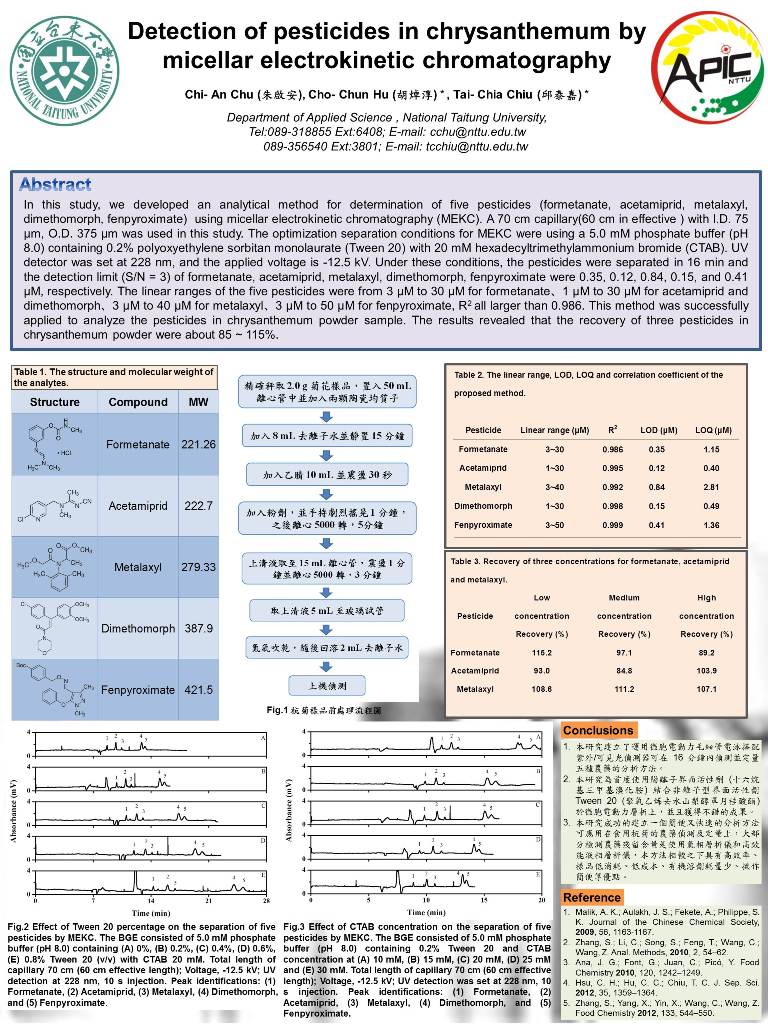
In this study, we developed an analytical method for determination of five pesticides (formetanate, acetamiprid, metalaxyl, dimethomorph, fenpyroximate) using micellar electrokinetic chromatography (MEKC). A 70 cm capillary(60 cm in effective ) with I.D. 75 μm, O.D. 375 μm was used in this study. The optimization separation conditions for MEKC were using a 5.0 mM phosphate buffer (pH 8.0) containing 0.2% polyoxyethylene sorbitan monolaurate (Tween 20) with 20 mM hexadecyltrimethylammonium bromide (CTAB). UV detector was set at 228 nm, and the applied voltage is -12.5 kV. Under these conditions, the pesticides were separated in 16 min and the detection limit (S/N = 3) of formetanate, acetamiprid, metalaxyl, dimethomorph, fenpyroximate were 0.35, 0.12, 0.84, 0.15, and 0.41 µM, respectively. The linear ranges of the five pesticides were from 3 μM to 30 μM for formetanate、1 μM to 30 μM for acetamiprid and dimethomorph、3 μM to 40 μM for metalaxyl、3 μM to 50 μM for fenpyroximate, R2 all larger than 0.986. This method was successfully applied to analyze the pesticides in chrysanthemum powder sample. The results revealed that the recovery of three pesticides in chrysanthemum powder were about 85 ~ 115%.
References: (1) Malik, A. K.; Aulakh, J. S.; Fekete, A.; Philippe, S. K. Journal of the Chinese Chemical Society, 2009, 56, 1163-1167. (2) Zhang, S.; Li, C.; Song, S.; Feng, T.; Wang, C.; Wang, Z. Anal. Methods, 2010, 2, 54–62. (3) Ana, J. G.; Font, G.; Juan, C.; Picó, Y. Food Chemistry 2010, 120, 1242–1249. (4) Hsu, C. H.; Hu, C. C.; Chiu, T. C. J. Sep. Sci. 2012, 35, 1359–1364. Zhang, S.; Yang, X.; Yin, X.; Wang, C.; Wang, Z. Food Chemistry 2012, 133, 544–550. |
|||
|
|
|||